

[Impressive] Lifting / Firmness / Asymmetry Correction[Strongest lifting effect currently available!] Ultherapy Prime (Ulthera 2)
![[Strongest lifting effect currently available!] Ultherapy Prime (Ulthera 2)](/_next/image?url=https%3A%2F%2Ffirebasestorage.googleapis.com%2Fv0%2Fb%2Fkkeutguro-7e583.firebasestorage.app%2Fo%2Fproducts%252Fguro%252Fen%252F1758779431336_a3cb6937-542f-422b-82d1-0b69e85d5d52_001-ezgif.com-png-to-webp-converter.webp%3Falt%3Dmedia%26token%3Dccccf40e-4b57-4729-b1f0-f4227d04ca99&w=2048&q=75)
[Strongest lifting effect currently available!] Ultherapy Prime (Ulthera 2)
[Same number of shots, different results] Ultherapy Prime (Ulthera 2) [Design first while seated] When lying down, sagging appears less severe than it actually is. While seated, we check the sagging lines, feel the areas directly, and plan the optimal tips, such as 4.5mm and 3.0mm, according to the thickness of each area. [Adjust with tilting while viewing the screen] The depth of the SMAS layer varies by area. If the SMAS layer is between tip specifications, it cannot be reached vertically. In this case, the tip is tilted diagonally to reach that depth. [Maintain standard 25mm length] One Ulthera shot is a line 25mm long. Reducing it also reduces the coverage area per shot. Kkeut Clinic honestly performs treatments with the standard values. * VAT not included
Options
Treatment Details



Ultherapy Prime is the latest model, a successor to the original Ulthera, often called 'Ulthera 2'.
Ulthera has one feature that other lifting devices do not: an ultrasound screen. It shows a real-time cross-section of the skin in the treatment area. Layers like the epidermis, dermis, fat layer, and the SMAS layer, which is the target for lifting, are all visible layer by layer.
The biggest change in Prime is that screen. It's larger and clearer, making the layer boundaries much more visible. However, better equipment doesn't automatically make the treatment more accurate. Ultimately, how closely that screen is observed determines the results.
Kkeut Oriental Medicine Clinic's Ulthera differs in these aspects.
Ultherapy Prime, The Kkeut Difference
One. We design while you are seated.
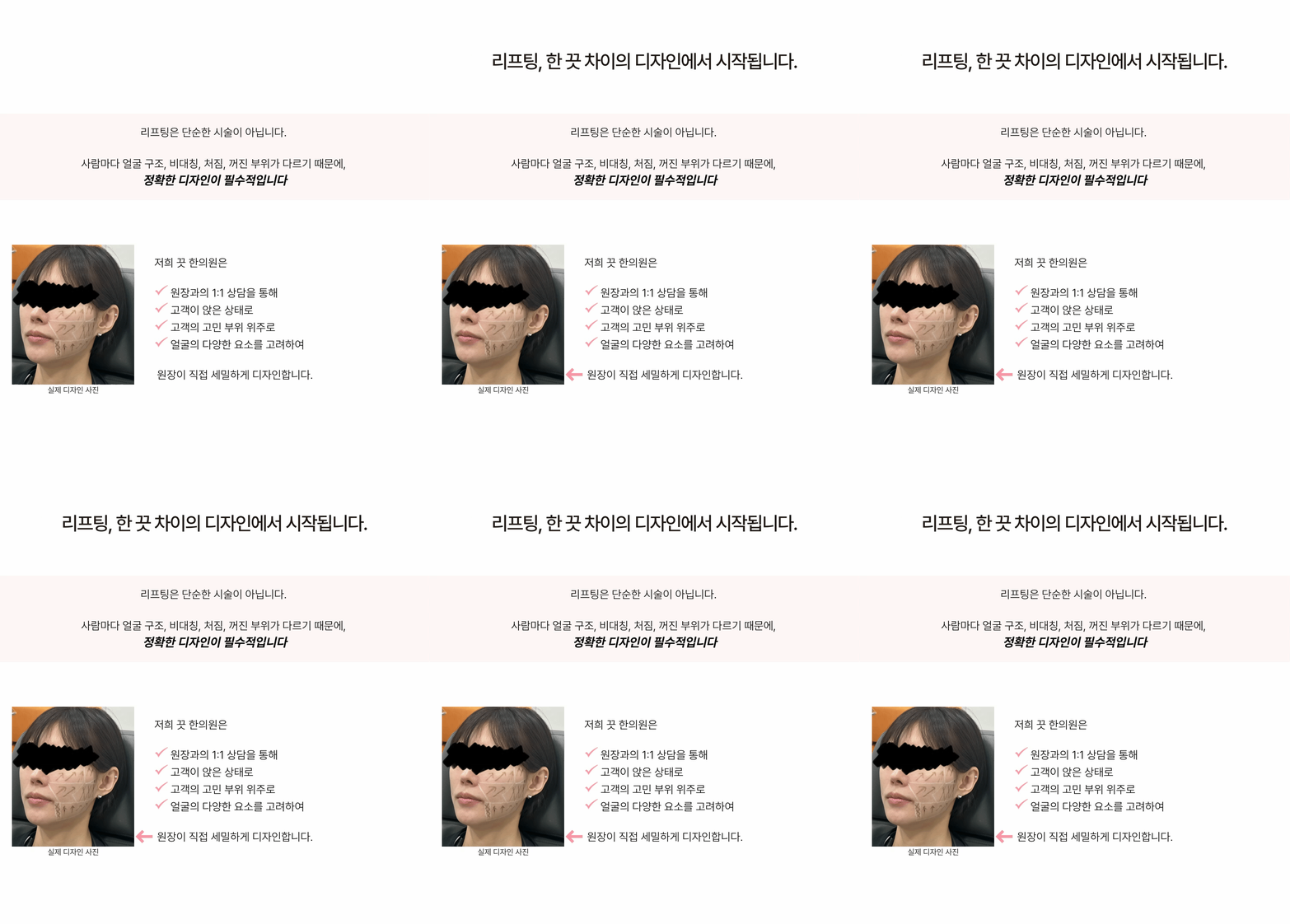
Although the treatment is received while lying down, the design is always created first while you are seated.
When you lie down, the direction of gravity changes, and sagging tissues are pushed backward and upward. A face viewed while lying down appears less saggy than it actually is. If you decide where and how much to lift in that position, the areas that truly needed it will be missed once you stand up.
There are two things we do at this stage.
First, we assess the actual state of sagging. We check which lines have collapsed, and where to apply stronger or weaker treatment, all while you remain seated.
Then, before beginning the actual ultrasound treatment, we manually feel and visually inspect to determine the skin thickness in each area. Even within the same face, the thickness above the cheekbones, under the chin, and on the cheeks all differ. Based on these thicknesses, we decide which areas will use the 4.5mm tip and which will use the 3.0mm tip.
In other words, tip selection is not decided spontaneously during the treatment, but rather planned and designed for each area before the procedure begins.
When switching tips during a procedure, it's easy for the thought 'let's just use the current tip for this area' to creep in. By first checking the thickness and making a plan, that possibility is eliminated.
This approach is necessarily different from a treatment that uses the same tip and settings across the entire face.
Two. Kkeut Oriental Medicine Clinic's Ulthera Tilting Skill
The plan established in the previous stage is based on manual palpation and visual inspection. While accurate, it's not perfect, as there are limits to information obtainable from outside the skin. A plan is a plan, but the inside of the body is only known by 'opening it up'. The tool for 'opening it up' is the ultrasound screen.
This is one of the clear differences between Shurink and Ulthera.
This might be a bit complicated, but understanding it will change how you view lifting procedures.
Ulthera tips have a fixed focal depth. The 4.5mm tip focuses at 4.5mm, and the 3.0mm tip focuses at 3.0mm. The depth set by the tip is precisely that point.
However, the depth of the SMAS layer we need to target varies from person to person and even from area to area within the same face. It's actually rare for this layer to be neatly located at precisely 4.5mm or 3.0mm, matching the tip specifications.
Let's say the SMAS layer is at 3.8mm. The 4.5mm tip would pass below it, and the 3.0mm tip would focus above it. If you apply the tip perpendicularly and fire, both would miss the target. Energy would be delivered, but the layer that actually needs treatment would not be targeted.
In such cases, we tilt the tip diagonally. By applying an angle, the actual focal depth changes, allowing it to reach layers that lie between the standard tip depths. This is called tilting.
To summarize, Kkeut Oriental Medicine Clinic's Ulthera treatment proceeds as follows: while seated, we palpate and visually inspect to plan the tip and intensity for each area. During the actual treatment, we confirm the layers on the screen and adjust the angle. Relying only on the screen without a plan leads to improvisation, and having only a plan without using the screen leads to inaccuracies. Both are necessary.
And this adjustment process takes time. We must check the SMAS layer's position on the screen for each area and readjust the angle where necessary. From the perspective of treatment speed alone, it's clearly a disadvantage. That's why it's also a step that is easy to omit.
Kkeut Oriental Medicine Clinic dedicates that time.
As a side note, depending on the design, there are cases where we intentionally target the fat layer instead of the SMAS layer. This is because areas with excessive volume cannot be effectively contoured by only tightening the SMAS. This choice is also only possible when observing the layers on screen.
Three. We provide a transparent record of your treatment today.
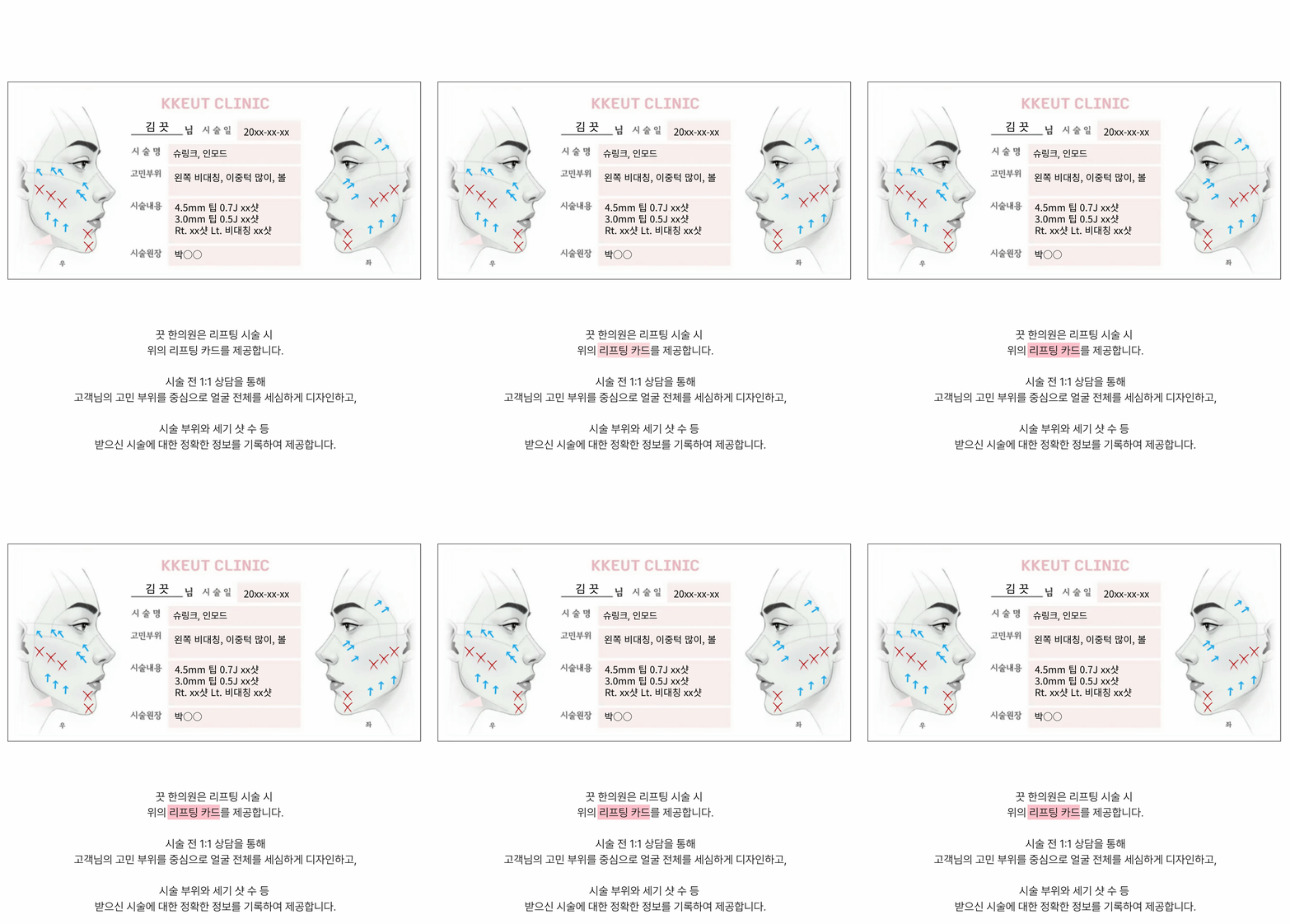
After the treatment, we provide you with a lifting card. It details which tips were used, how many shots were administered to each area, and the intensity applied to each region.
After a lifting treatment, there's usually no way to verify what exactly was done. Since it happens on your face, you can't see it yourself, and typically you only hear the total shot count. 'I received 600 shots' — that's often the only record you have.
With a card, things change. It records where the focus was this time, and provides a basis for discussing what to do differently next time you visit. Over multiple treatments, your personal treatment history accumulates.
Everywhere claims to perform designed treatments. We put that claim on paper. Making it verifiable for you is our way of showing confidence.
Four. 25mm, We do not shorten it.
Even with the same 600 shots, the content can differ. We want you to be aware of this.
One shot of Ulthera is not a dot, but a line. It works by continuously delivering ultrasound energy at very short intervals to create a single line, and then arranging these lines parallel to each other to cover the face.
The standard length of this line is 25mm. It is the device's default and recommended value.
However, this length can be shortened in the settings.
What happens if it's shortened? The treatment becomes faster because the delivery time per shot is reduced. However, the area covered by a single shot also decreases proportionally. Shorter lines require significantly more shots to cover the same area. Ultimately, while the shot count might still be 600, the actual amount of energy delivered differs.
The numbers are the same, but the content is different. This is something that can happen in lifting treatments.
Kkeut Oriental Medicine Clinic performs treatments using the standard 25mm length. We will also transparently show you the device's settings screen before the treatment.
Procedure Steps
첫 상담부터 마무리까지의 실제 진행 순서를 확인하세요.
- 01
Step 1. Personalized Consultation
- 02
Step 2. Custom Design by Medical Staff
- 03
Step 3. Procedure Execution
- 04
Step 4. Provision of Lifting Treatment Information Card
- 05
Step 5. Application of Soothing Cream after Procedure
시술 기본정보
시술 시간, 마취, 회복, 유지기간을 한 번에 확인하세요.
TIME
Within 20-30 minutes
ANESTHESIA
No anesthesia (if necessary)
RECOVERY
Immediate return to daily life
DURATION
6-12 months
Ideal For
One Fine Difference makes real results.
- KKEUT POINT 01
Individuals concerned about a changed impression due to sagging facial lines may consider this treatment.
Q&A
고객님들이 가장 많이 물어보시는 내용을 모았습니다.
How many shots should I receive?

Since it's a method that fills the entire face with thin lines, a minimum number of shots relative to the area is required. We usually recommend 600 shots or more. However, the appropriate number of shots varies depending on face size, degree of sagging, and the area requiring concentrated treatment. It is most accurate to decide together when designing during the consultation.
I've heard it's very painful; should I get sleep anesthesia?
It is true that there is stimulation as energy enters the deep layers. However, most people receive it with cream anesthesia, and many even receive it without anesthesia. We do not recommend sleep anesthesia. There's a reason for this. Ulthera is a procedure where ultrasound is delivered while the tip is in close contact with the skin. This close contact must be maintained for the energy to be accurately delivered to the planned layer. However, under sleep anesthesia, your head might move unknowingly. If the tip lifts at that moment, the treatment position can shift, and in some situations, it could be dangerous. If you are awake, this will not happen. The sensations you feel during the procedure can also serve as signals telling you where the energy is being delivered. If you are concerned about pain, we can assist you with cream anesthesia. Please feel free to let us know.
I don't have much facial fat and am worried about cheek hollowing.
The SMAS layer targeted by Ulthera is a different layer from volume. Sagging can occur due to excess fat, but also if the SMAS layer loosens even with less fat. In fact, individuals with less volume may experience more noticeable collapse of facial lines due to weaker supporting structures. Therefore, it is a necessary treatment regardless of whether you have much fat or not. However, the less volume you have, the more crucial it is to design the treatment to precisely target only the SMAS while avoiding the fat layer. This is where the importance of design and tilting, as mentioned earlier, comes in. Since it varies by individual condition, we recommend consulting before making a decision.
When do the effects become noticeable?
You may feel a slight tightening sensation immediately after the procedure, but this is more of a temporary reaction. In the initial stages, swelling often accompanies it, which is a natural reaction as strong energy enters the deep layers. While there are individual differences, changes usually start to appear gradually after about 1 month. Since it is a procedure where tissues undergo a remodeling process after thermal stimulation, it requires time.
How often should I receive treatment?
This depends on the degree of sagging, so a consultation is necessary. Generally, if you've received the recommended number of shots, we suggest intervals of 6 months to 1 year. If the shot count was insufficient and you're receiving it in parts, we guide you to complete the treatment with 1-month intervals.
Are there any recommended treatments to combine with this one?
Ulthera addresses deep layers. Surface texture and elasticity are separate areas, so the layers don't overlap. Therefore, many people combine it with treatments that address the superficial layers, such as Denssity, Onda, or Tensharma. The best combination depends on your skin condition, so we will guide you during your consultation.
Cautions
Results = Treatment × Aftercare. Please follow the notes below.
You may experience a mild sensation of heat, swelling, or pain in the treated area for about 1-2 weeks.
Occasionally, temporary stimulation of subcutaneous nerves may cause a feeling of numbness in the affected area.
It is advisable to avoid applying excessive pressure to the treated area.