
[Impressive] Lifting / Firmness / Asymmetry CorrectionKkeut Signature Lifting | Onsella Bollsella Bolda | Cheonho Kkeut Oriental Medicine Clinic

Kkeut Signature Lifting | Onsella Bollsella Bolda | Cheonho Kkeut Oriental Medicine Clinic
Personalized Signature Lifting We recommend the most suitable lifting for you. *VAT separate
Options
Treatment Details





Ultherapy Prime is the next-generation model of the existing Ultherapy device, often referred to as 'Ultherapy 2'.
Ultherapy treatment is characterized by the ability to view cross-sections of the skin in real-time via an ultrasound screen. On this screen, various tissue layers are clearly visible, including the epidermis, dermis, fat layer, and especially the SMAS layer, which is the primary target for lifting.
Compared to the previous model, Ultherapy Prime features a larger and clearer screen, making it easier to identify the boundaries between skin layers. However, improved equipment performance alone does not guarantee precision in treatment. In practice, skilled practitioners who meticulously observe and utilize the screen are crucial.
We consider several important factors during the Ultherapy treatment process.
The Delicate Approach of Ultherapy Prime Treatment
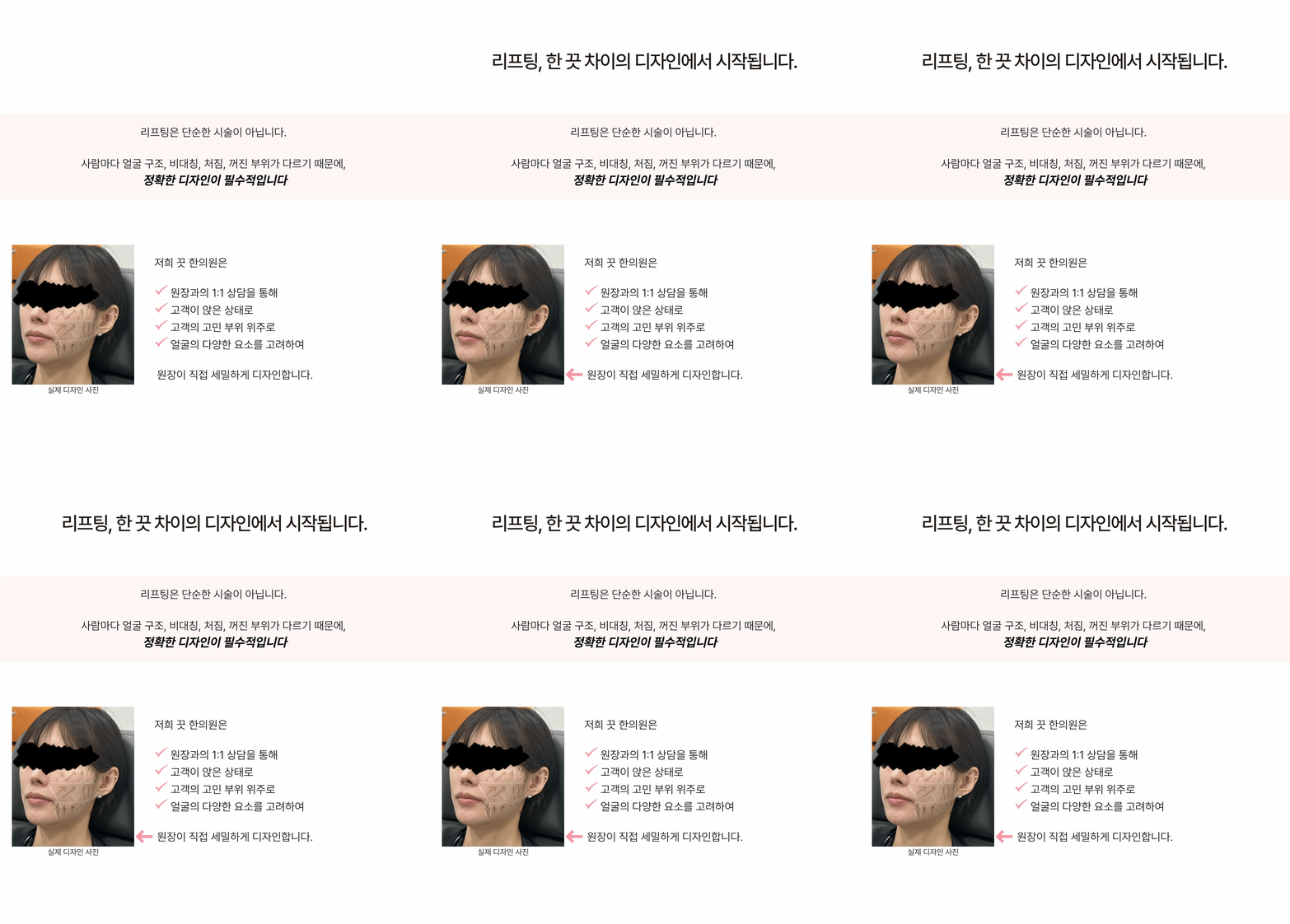
First, we establish the treatment design while the patient is in a seated position.
While the treatment itself is performed with the patient comfortably lying down, the design phase begins with the patient seated.
When lying down, the effect of gravity changes, causing sagging areas to be pulled upwards, making them appear less saggy than they actually are. If a treatment plan is created in this position, there's a possibility that the desired lifting effect may not be fully realized once the patient stands up.
During this design process, we primarily check two things.
First, we meticulously observe the actual degree of sagging while the patient is seated. We plan in advance which lines are primarily affected and at what intensity the ultrasound energy will be applied to each area.
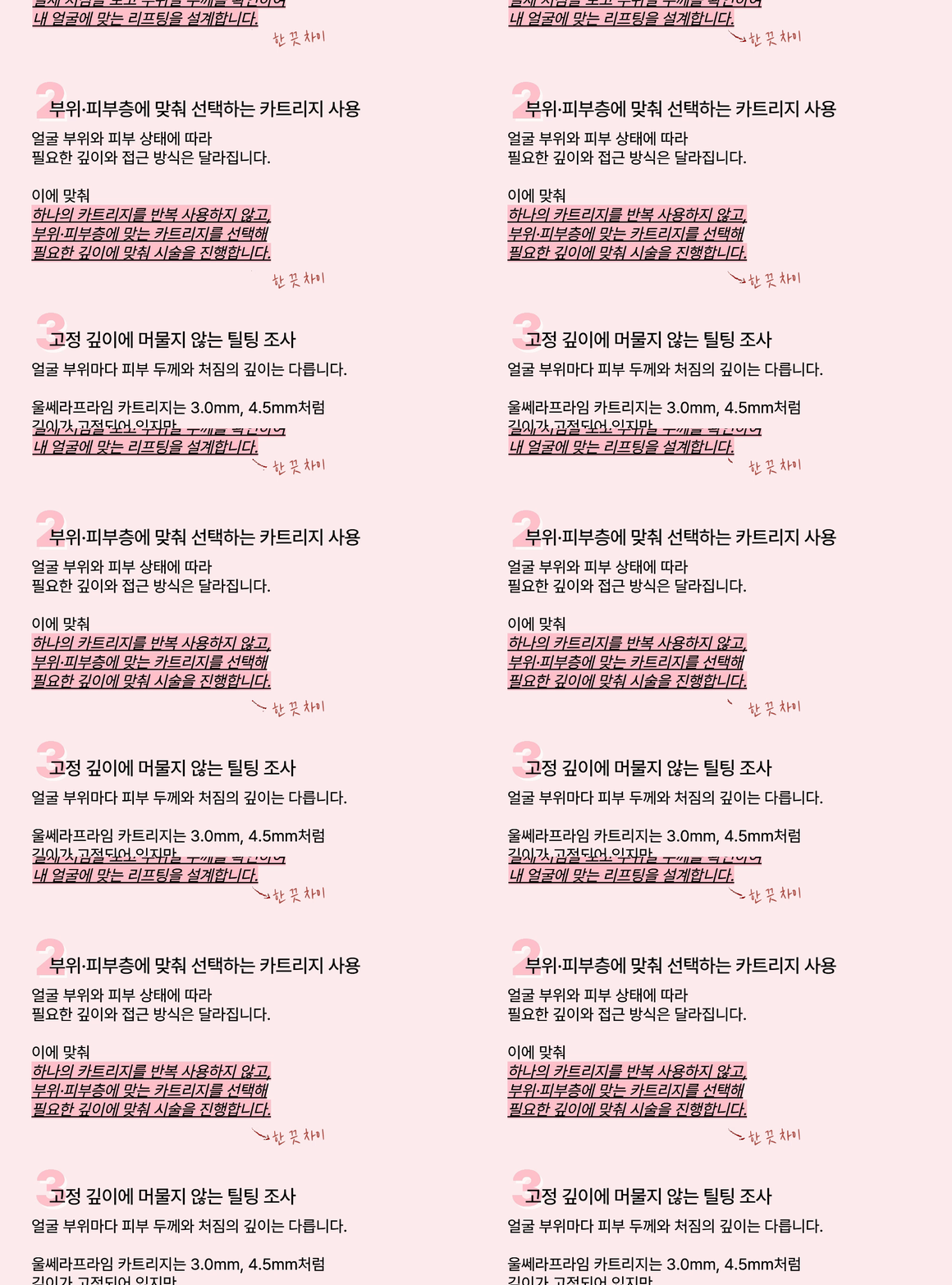
Next, before starting the ultrasound application, we physically palpate the skin and visually inspect it to determine the skin thickness of each area. Since skin thickness varies across different facial areas, such as above the cheekbones, under the chin, and on the cheeks, we decide whether to use a 4.5mm tip or a 3.0mm tip based on this assessment.
Therefore, tip selection is not made spontaneously during the procedure. We establish a detailed design for each area before the treatment begins and proceed according to that plan.
If tips are frequently changed during treatment, there might sometimes be a tendency to apply the same tip being used to a specific area. However, by checking skin thickness and planning in advance, we can proceed with the treatment as scheduled without such spontaneous decisions.
Such meticulously planned treatment differs fundamentally from an approach that applies a uniform tip and settings across the entire face.
Second, we utilize our unique Ultherapy tilting technique.
The plan established in the previous step is based on information gathered through touch and visual inspection. While precise, there are clear limitations to information obtained from the exterior of the skin. To truly understand the inside of our body, we need to look directly, and the ultrasound screen serves precisely this role.
This is also one of the key features that distinguishes Shrink from Ultherapy treatments.
While it might seem somewhat unfamiliar, understanding this information can help enhance your comprehension of lifting treatments.
Each Ultherapy tip is designed to focus at a predetermined depth. For example, a 4.5mm tip precisely delivers energy to a depth of 4.5mm, and a 3.0mm tip to a depth of 3.0mm.
However, the actual depth of the target SMAS layer varies from person to person and differs even within the same face. It is rare for this SMAS layer to precisely match the fixed specifications of the tips, such as 4.5mm or 3.0mm.
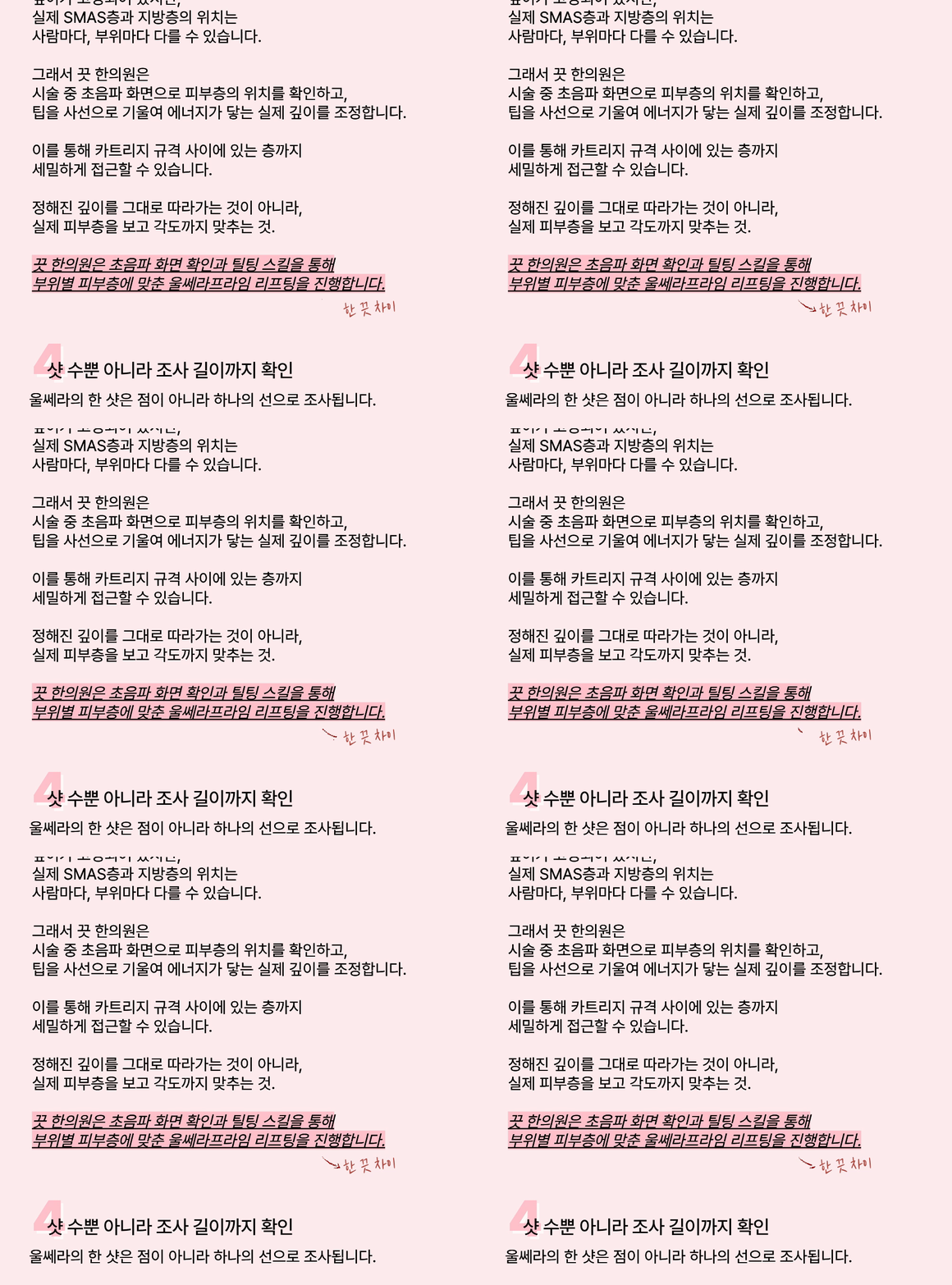
Let's assume the SMAS layer is located at a depth of 3.8mm. A 4.5mm tip would deliver energy deeper than the SMAS layer, while a 3.0mm tip would focus on a shallower area. If the tip is used only vertically, it might be difficult to deliver precise energy to the actual target layer in both scenarios.
In such situations, we use the tip at an angle. Angling the tip adjusts the actual focal depth, allowing energy to be delivered to various depths between the standard tip specifications. This technique is called 'tilting'.
To summarize, our Ultherapy treatment proceeds as follows: While the patient is seated, we identify the characteristics of each area through visual inspection and palpation to plan the tip type and intensity. Then, during the actual ultrasound application, we monitor the skin layers in real-time on the screen and adjust the tip angle as needed. Relying solely on the screen without a plan can lead to an impromptu treatment, and having a plan but neglecting screen verification can cause us to miss the target layer. Both of these processes are crucially utilized.
This detailed tip angle adjustment process takes a considerable amount of time. This is because the position of the SMAS layer must be precisely confirmed on the screen for each area, and the tip angle must be readjusted accordingly. If only treatment speed is considered, this process might seem inefficient and is often easily overlooked.
We allocate ample time for such precise treatments.
For reference, there are cases where, depending on the treatment design, the fat layer is selectively targeted instead of the SMAS layer. This is especially true for areas with excessive volume, where lifting only the SMAS layer might not achieve the desired improvement. This approach also requires confirming the exact layer through the ultrasound screen.
Third, we transparently record and provide the details of the treatment.
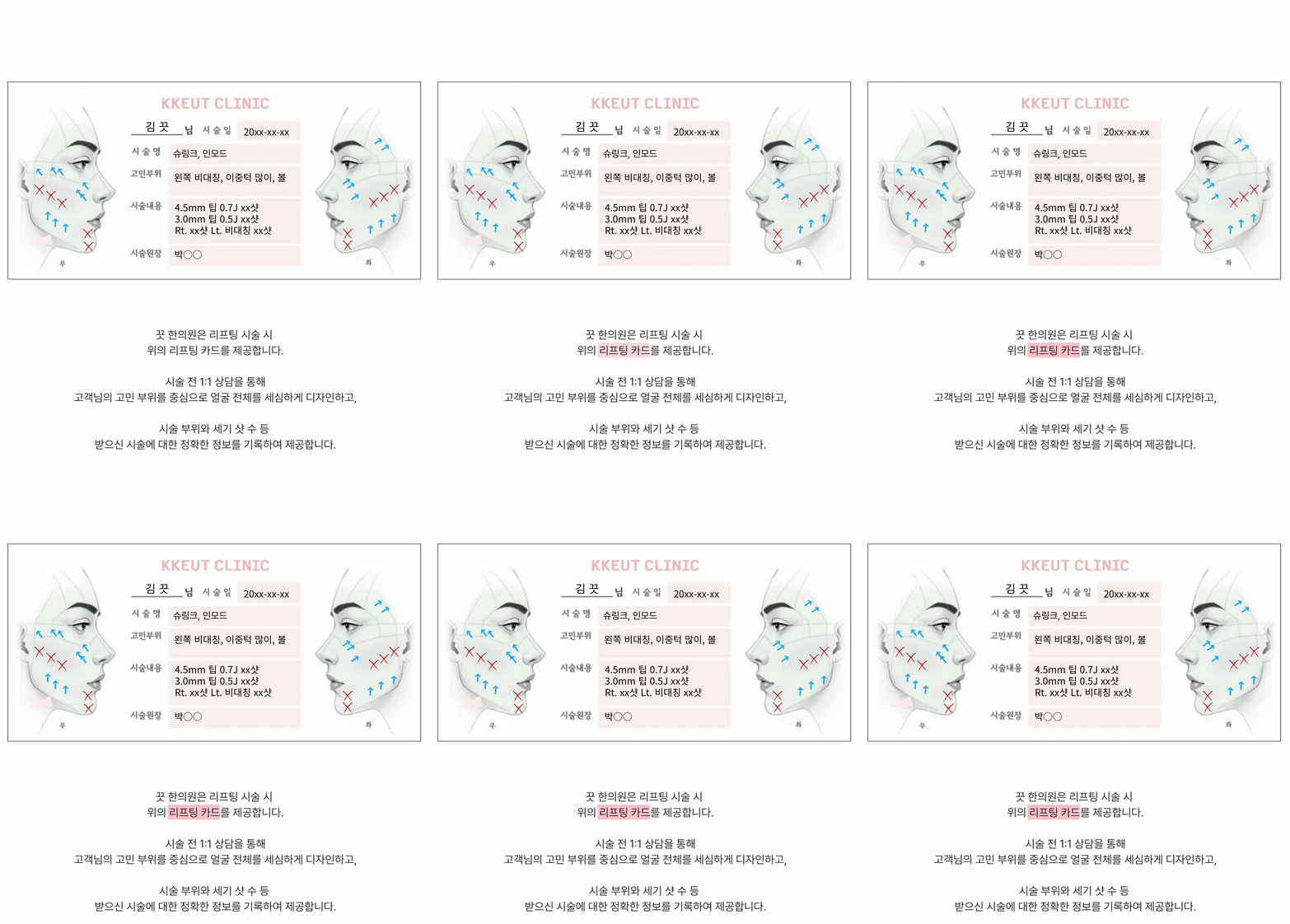
Upon completion of the treatment, we provide you with a lifting card. This card contains detailed information about the treatment, including the type of tip used, the number of shots delivered to each area, and the energy intensity applied.
Generally, after lifting treatments, it's often difficult for patients to verify exactly what procedure was performed. Due to the nature of facial treatments, they cannot be seen directly, and most patients typically only receive information about the total number of shots.
However, with this card, the situation can change. It clearly records which areas were focused on in the current treatment and serves as concrete data for discussing differences from previous treatments or additional plans during your next visit. If you receive treatments multiple times, your personal treatment history can be systematically managed.
Many places emphasize pre-treatment design, but we meticulously record and preserve these details in writing. Allowing our clients to directly verify the treatment details is part of demonstrating the transparency of our treatment approach.
Fourth, we maintain a 25mm treatment length per shot.
It's important to note that even if the total is 600 shots, the actual content of the treatment can differ.
In Ultherapy, a 'shot' doesn't refer to a simple dot, but rather a continuous line created by delivering ultrasound energy in short, successive bursts. This method involves arranging these lines across the facial area without overlapping to deliver energy.
The basic length of this ultrasound line is 25mm, which is the standard and recommended setting for the device.
However, this line length can be adjusted and shortened in the device settings.
If this length is shortened, the treatment time per shot can be reduced, speeding up the procedure. However, the area covered by each shot also proportionally decreases. Consequently, more shots are required to deliver energy to the same area, and even if the total shot count is the same, the actual amount of energy delivered to the treated area can differ.
This means that even if the number of treatment sessions appears to be the same, the actual content of the treatment can vary.
For Ultherapy treatments, we adhere to the standard 25mm length. We transparently provide the device settings screen for you to directly verify before the procedure.
Procedure Process
See each step, from your first consultation to completion.
- 01
Customized Consultation